Monday, October 15, 2018
Teaching Day 1
I felt like a child on the first day of school. I woke up at 5:30 am ready to go. Sadly we did not start until 8 am so I did some personal reading and even reviewed some of my slides to make sure they were correct. After a traditional Haitian breakfast I made the walk over to the school to start the day.
Myself and the physiotherapy class:
At 7:55 am all of the students were in the commons of the school lined up. I learned that like in America they respect the flag before school starts. The entire school sang the anthem as the flag slowly ascended to the top. The passion in each students eyes and voices as they sang was so strong. I got chills on my arms as the song concluded and each student rushed into their classroom. I would expect this in grade school, but to see 20-40 year old adults doing this shows how much this country means to them.
I prepared 6 lectures for the day and knew it would be a long day for them. I started by getting to know the 7 students who are 4th year physiotherapy students. They have made it so far and I could tell from the first few minutes that they were all hard workers. After setting the objectives and going over the syllabus I started us with an icebreaker. I asked two very deep questions alongside the basics to help get to know them better. The first question was "what is your biggest fear" and the second was "if you won the lottery what are the first three things you would do". I was very impressed with their answers and learned a lot more about their culture and emphasis on community.
During the first half of the morning we focused on Clinical Reasoning and reviewing concepts from the foundational courses. They have retained a lot of the content which made the conversation much more interactive.
After lunch we worked on expanding hypothesis generation to improve creating differential diagnosis lists. I learned that as an education system, the Haitian students have very strong memorization skills as this is the main learning style they are taught. They struggle with more abstract thinking and application of knowledge. These students in the physio program have been working hard on these concepts and I can tell they are beginning to learn this skill and will improve it as the year continues.
I was very impressed with their conversation about clinical experiences. Many of the students expressed that the way of thinking they have been learning in this physiotherapy curriculum is very different than how clinicians in the country are practicing. They were excited to apply all of the knowledge they have learned prior to the rotation, but felt many of the therapists were not doing thorough assessments and still using very outdated treatment styles. It was so inspiring to see motivated therapists who want to improve the profession and challange the status quo of current practice. I hope that this week only adds wood to that fire.
After class I shot the basketball around on the outdoor court near the campus. One of the students saw me and we played a little one-on-one. Not playing ball in over a year and being in 90 degree heat left me exhausted by the end.
Chicken, rice, and fresh vegetables was a great end to the night.
I spent the night working on some of the lectures and self reflecting. I have a long way to go with my skills as an educator but after doing it for 8 hours straight I can say I love it!
Haiti Manual Therapy 2018: Travel Day and Exploration
Olivia and I enjoyed ourselves with great friends on Saturday as we watched 2 of our friends share vows in Annapolis, MD. Sadly the night was cut short and I headed to the airport for my trip to Haiti.
The flights went well and I landed in Haiti early afternoon. I forgot how nice it was to travel for 5 hours in the air and stay in the same time zone!
When I arrived I was greeted by a driver who helped grab my supplies. After we got my stuff to the car we waited for 5 other people. I learned on our drive to Leogane, Haiti. The group consists of 2 professors, 2 undergraduate students, and 1 master student. They are from the University of Notre Dame in the engineering field. This group is doing some great work to help with disaster response after storms and natural disasters. I learned so much from them and I am excited to learn more about their projects this week. I am always so humbled to realize how little I know about other fields of study and how much they can impact the world!
We arrived in Leogane at the school compound 2 hours later and were greeted by a very nice guest house and facility. After getting settled in, we had Pumpkin Soup for lunch and the students and I found the local beach. On the way we met a young man who educated us on the area. I really enjoyed the sights, sounds, and smells as we walked the streets of this small coastal town.
For dinner we had a traditional rice and beans, chicken, and vegetable meal. After dinner I spent the night looking over material for my first day of teaching.
This week I will be teaching the Advanced Manual Therapy course for the 4th year physiotherapy students. The class has 7 students who have made it this far in the program! The degree is through the Episcopal University of Haiti (UNEPH) and the Physiotherapy/Occupational Therapy degree programs are under the Faculte des Sciences Rehabilitation d'Leogane (FSRL).
It has been a great learning opportunity creating the content for this course. I have had so much help from the instructor who taught the Musculoskeletal course earlier in their education, AJ and Aaron from SU, and my colleague Adam from the UIC Manual Therapy Fellowship. I can't believe it has all come together and the week of teaching begins tomorrow!
Saturday, August 18, 2018
Last Days (Clinic Day 9, 10, and Saturday)
Thursday and Friday:
As the week ends, I decided to sum up the days a little more quickly.
Thursday we arrived at the clinic and one of the physios was leading prayer. It was a great experience to pray alongside the patients to start the day. I wish I had seen it earlier and joined them every morning.
I mentored two students with one being a students second mentoring session and the second being one of the weaker ones of the trip. The first was George who was the head of the department with 30 years experience that I saw last week. He wanted to show he had learned from the first time and I could tell he was really trying to integrate the lessons from last week. He still needed a lot of guidance with the critical thinking but he was much more thorough with the questioning and trying to gather information. The focus today was to work on using objective impairments to treat. We worked on doing muscle testing to figure out which to treat and to assess joint mobility to figure out where to mobilize. He said that he has always just treated based on what the x-ray showed or just where the patient was experiencing pain. I think that George will continue to grow so much during the residency year due his openness for change.
The second student was from a rural area of Kenya and he has been practicing 11 years. He had trouble doing basic measurements and testing all of the simple things. I had to do a lot of teaching with him. The most troubling part of his session was that he filled out all of the objective examination based on looking at the patient. He explained that he rarely tests and just guesses. I really tried to stress that this way of practicing medicine is unethical, not safe, and not helpful. After the session I spoke with residency staff and they were aware of weak he was, but said they changing his practice would help many patients because of where he works. They said the lower skilled therapists tend to work in the rural areas. I loved that they are trying to not just make the good therapists better, but trying to improve the care as a whole.
At night our group went out for an Ethiopian meal with some of the residency staff. I was the only one from our group who had tasted this type of food so it was a great cultural experience for all. After we got to experience reggae night at a local bar. We had a great time.

On Friday we had a half day so we only had a few patients. Emily and I mentored together at first and then Lauren asked for some mentorship with a highly irritable case. At the beginning, he had severe pains and fear of movement. After some education, manual therapy to the abdominal muscles and obliques, and graded exposure to movement and dissipation he left with much less pain and was able to squat and even do a sit up! It was a complete change and was so happy to end my clinical experience with this patient.
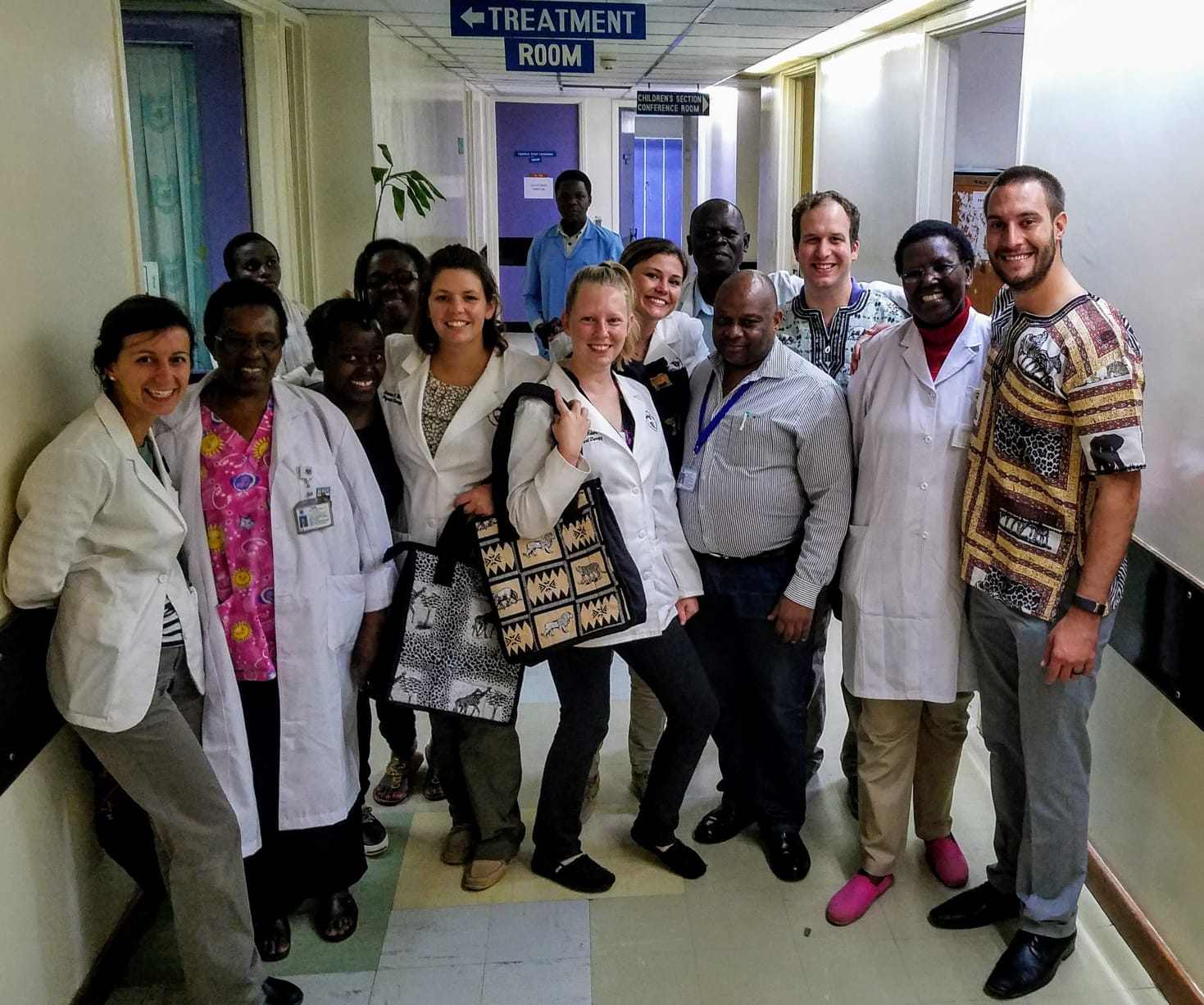
Our group presented gifts to the mentors and staff which they really enjoyed. The staff also presented us with gifts for our education and collaboration over the past two weeks. I was presented with an amazing handmade shirt. It was a perfect style for me and I could tell they picked out the fabric based on what I had been wearing all week and my personality. It was very thoughtful.
In the afternoon the students headed to the airport after our final reflection over lunch. All 6 of us really grew and learned a lot from this experience. It was hard to believe how many things we were able to do and accomplish in two weeks time. For me, my low was that I was unable to treat more patients. With mentoring you are focused on teaching so it is more indirect patient care. It is also slower so we could not see as many patients as I would typically see I a day at home. But our focus was to impact beyond our time here, which brings me to my high which was the idea that we were able to provoke a change in thinking about patient care. Our influence as educators, if it resonates, will make a much larger impact on the country then the time we spent here. That is the best part of this work and experience, sustainability and progress!

At night, Emily and I went out with Martin for a few hours to enjoy our last time together. It was a great time!
Saturday:
Many people who stay at Grace House come for the week and travel on weeekends so it was a ghost town when we woke up for breakfast.
Emily and I packed and had our final meeting with Erastus and Martin.
We had a great trip, so much that we ran out of money on the last day which limited what we could do! Luckily we had seen everything we wanted to except the Karen Blixen Museam. I did some research on her instead so at least I got to learn about her impact on Kenya.
We headed to the airport and prepared for our long flights home. I plan to use that time to reflect, work on my Haiti course lectures, and prepare for the next two weeks so I can hit the ground running on Monday.
Reflection:
Overall, this was such a great experience for myself as a therapist, global citizen, and humanitarian. My passion is to learn the world and make an impact as much as possible. Each journey has been teaching me more and more about myself and the world around me. I feel so lucky to have opportunities like these and hope that everyone who read this blog was able to learn more.
Thanks for joining me on this journey!
-Kyle
As the week ends, I decided to sum up the days a little more quickly.
Thursday we arrived at the clinic and one of the physios was leading prayer. It was a great experience to pray alongside the patients to start the day. I wish I had seen it earlier and joined them every morning.
I mentored two students with one being a students second mentoring session and the second being one of the weaker ones of the trip. The first was George who was the head of the department with 30 years experience that I saw last week. He wanted to show he had learned from the first time and I could tell he was really trying to integrate the lessons from last week. He still needed a lot of guidance with the critical thinking but he was much more thorough with the questioning and trying to gather information. The focus today was to work on using objective impairments to treat. We worked on doing muscle testing to figure out which to treat and to assess joint mobility to figure out where to mobilize. He said that he has always just treated based on what the x-ray showed or just where the patient was experiencing pain. I think that George will continue to grow so much during the residency year due his openness for change.
The second student was from a rural area of Kenya and he has been practicing 11 years. He had trouble doing basic measurements and testing all of the simple things. I had to do a lot of teaching with him. The most troubling part of his session was that he filled out all of the objective examination based on looking at the patient. He explained that he rarely tests and just guesses. I really tried to stress that this way of practicing medicine is unethical, not safe, and not helpful. After the session I spoke with residency staff and they were aware of weak he was, but said they changing his practice would help many patients because of where he works. They said the lower skilled therapists tend to work in the rural areas. I loved that they are trying to not just make the good therapists better, but trying to improve the care as a whole.
At night our group went out for an Ethiopian meal with some of the residency staff. I was the only one from our group who had tasted this type of food so it was a great cultural experience for all. After we got to experience reggae night at a local bar. We had a great time.

On Friday we had a half day so we only had a few patients. Emily and I mentored together at first and then Lauren asked for some mentorship with a highly irritable case. At the beginning, he had severe pains and fear of movement. After some education, manual therapy to the abdominal muscles and obliques, and graded exposure to movement and dissipation he left with much less pain and was able to squat and even do a sit up! It was a complete change and was so happy to end my clinical experience with this patient.
Our group presented gifts to the mentors and staff which they really enjoyed. The staff also presented us with gifts for our education and collaboration over the past two weeks. I was presented with an amazing handmade shirt. It was a perfect style for me and I could tell they picked out the fabric based on what I had been wearing all week and my personality. It was very thoughtful.

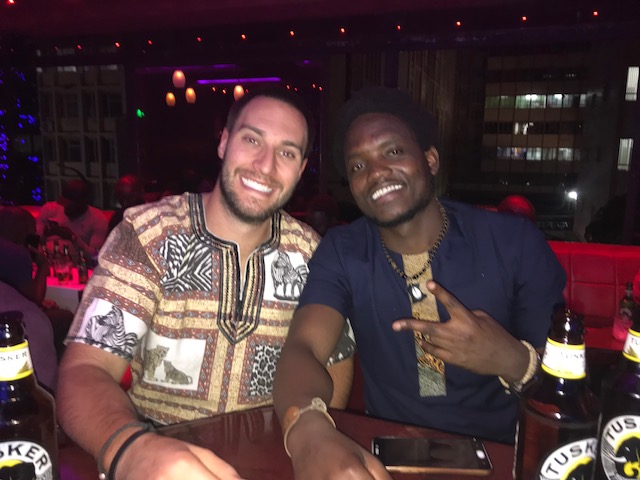
(Some photos with our driver DJ Ken! He made our travel so much fun.)
At night, Emily and I went out with Martin for a few hours to enjoy our last time together. It was a great time!
Saturday:
Many people who stay at Grace House come for the week and travel on weeekends so it was a ghost town when we woke up for breakfast.
Emily and I packed and had our final meeting with Erastus and Martin.
We had a great trip, so much that we ran out of money on the last day which limited what we could do! Luckily we had seen everything we wanted to except the Karen Blixen Museam. I did some research on her instead so at least I got to learn about her impact on Kenya.
We headed to the airport and prepared for our long flights home. I plan to use that time to reflect, work on my Haiti course lectures, and prepare for the next two weeks so I can hit the ground running on Monday.
Reflection:
Overall, this was such a great experience for myself as a therapist, global citizen, and humanitarian. My passion is to learn the world and make an impact as much as possible. Each journey has been teaching me more and more about myself and the world around me. I feel so lucky to have opportunities like these and hope that everyone who read this blog was able to learn more.
Thanks for joining me on this journey!
-Kyle
Thursday, August 16, 2018
Clinic Day 8 and Inservice
The midway day of the week was an eventful day. All of the mentees were late so we started by mentoring OMT therapists. Once the two mentees arrived, two others also showed up who were not on the schedule. This lead to a hectic morning.
When the first resident arrived we started the evaluation quickly to try to make up time. This patient was post operative for a shoulder arthroscopic procedure in May. He had been in therapy but was still in pain, had limited with function, and limited range. After the subjective I asked the student if they noticed any yellow flags. He picked up on the fear avoidance to movement and hyper fixation on pain. We worked on how to educate about tissue healing after surgery, emphasis on load to improve function, and use vs disuse. The patient appeared less tense and guarded after this education.
The objective portion of the exam worked on handling and technique for range of motion and joint mobility assessment. He learned quickly and by the end the patient said the handling was very close to my technique.
Exercise prescription was lacking in his education so I also put a strong emphasis on teaching exercises, technique, and dosing to help improve his concept of how and why to give exercises.
The second student has been strong so far in residency and choose to pick a complicated patient to challenge herself. I admired her desire and was excited for the session.The patient reported with low back, leg, neck, and shoulder pain. She has had 18 surgeries in the past 8 years along her neck, lumbar spine, shoulder, and abdomen. She would be what we call a complicated patient at home. I could tell the student was overwhelmed, so I jumped in a little to try to help her out. I worked on trying to address function and patient beliefs to help drive the session. Her biggest aggravating factor was standing in place and her relieving factor was walking. This did not make sense to the student so I had to act out and think about this to come to a hypothesis of what could be driving symptoms. She began with 9/10 standing pain and burning down her leg after 3 minutes of standing. After addressing the abdominal region with some manual therapy and motor control training in supine and standing we reassessed her standing. She was able to stand with 1/10 pain and no burning symptoms down her leg after over 18 minutes of standing. The big take home point for this complicated patient was to listen to her story, educate and give hope, find impairments, and work on function. The case could not have gone any better and I was so happy to have had this teaching moment with her.
With such a busy morning, I worked way past lunch so after a short time to clear my mind, I started to set up for my inservice presentation. My topic was clinical reasoning and evidence based practice. This lecture is an expansion of a lecture I gave in Ghana a few years ago and their national physiotherapy conference. The topic and style of presentation challenged everyone’s thinking and wrapped up the large emphasis I had been placing in mentorship all week. I was worried how it would be received, but I had 3 questions during the talk and over 45 minutes of discussion after I was finished. I loved to see they took the challenge and were thinking of ways to improve their practice.
After a busy day we went out to dinner with the head of the therapy department for goat. We wanted to try something new, but he had decided we would do this meal again and so it was the final say. At the meal his friend, Wilson, presented us with tea from his company to bring back and share with our American friends. It was such a nice gesture and we were very grateful.
Wednesday, August 15, 2018
Clinic Day 7
Clinic began with another student who has learned how to practice but has created shortcuts and fell into the system of treatment. He made many assumptions about the patient, used the script as his primary clinical reasoning, and did not try to dive deeper into the patient during the subjective. With guidance he created strong differentials and had a much better understanding of the patients pathology. The patient was a young man with a knee injury from a motorbike accident. His injury was in December and did not start PT until today which shows how slow the system can be here in Kenya. He learned how to better use the objective measures to drive treatment and how to treat more functionally with exercises of a younger, higher level patient. The patient reported with a better confidence with movement and what he needed to do for strengthening. Andrew, the student, learned about how to determine duration and frequency of treatment today. He wanted to see the patient 2x a week only because that is what he always does. However the patient drove 800 km and had to stay overnight for just one visit. After some explanation he was able to understand why the patient should only come every few weeks with an emphasis on HEP and self management.
The second student came late so I worked with one of the stronger OMT therapists at the hospital and Kala, one of the SU students, on a foot/ankle case. The focus was on using impairments vs pain to drive treatment. The patient had a fusion of the mid foot due to severe foot pain and deformity. His biggest limitation found during the exam was gastrocnemius/soleus weakness and hypomobility and limited dorsiflexion of the 1st metatarsal phalangeal joint. It was a great experience to use gait analysis, manual assessment, and questioning to challenge the thinking of both the advanced clinician and student at the same time. I really enjoyed this time with them.
After that I had a few minutes so I walked around the clinic and found Tony in the Pediatrics room with Juliet. They were working with a one year old patient post meningitis. Her developmental level was about the level of a 3 month old. I enjoy this age and really enjoyed joining in with this case. I was able to use some of my past experience to help provide some ideas and also learn some treatment strategies from both Tony and Juliet. This made me realize how much I miss treating the pediatric population.
Before lunch the second student finally arrived (1 hour late but apparently within the Kenyan understood late time). Her patient was one who was seen by a newer therapist 8 times before this visit. Emphasis today was determining current effects of treatment, reassessing all impairments, and determining the plan of care going forward. She had some trouble with the subjective like many of the other students and needed guidance during most of the objective aspect and intervention. After the session I learned that she is in the residency program for orthopedics, but her job is inpatient on the wards. So sadly she does not get to practice or implement much of her coursework or mentoring into practice during this year. Erastus, one of the lead teachers in the residency, explained that many of the employers due to not understand the residency and how each student should be working in orthopedics to work on the skills they are learning. Hopefully as the program continues, the employers will see the value and make adjustments to their thinking.
After clinic, Emily Tony and I went on a run and did a workout because of the nice weather. After that we were given the opportunity to watch the local club rugby team. We got to meet some of the players, talk to the physiotherapist, and enjoy the practice. It was a great experience for me to learn more about rugby and compare/contrast the sport to American football.
Tuesday, August 14, 2018
Clinic Day 6
The first student today was a great therapist. We are working with Cohort 6 which is the next grade. They have taken al of the didactic coursework for the is residency and half of the mentorship. His patient had low back and knee pain. With a sound foundation I was able to challenge his thinking and reasoning. His reasoning was strong and his examination was one that I would compare to a third year DPT student from America. After this session we had great discussion about movement patterns, muscle activation, and clinical reasoning principles.
After that patient, I co-treated with one of the lead therapists Wilfreda. She has been practicing for over 30 years and her son is Martin. Her patient was very challenging. He is coming with radicular leg pain and a Severe lateral shift. She has been working with him for 8 visits with almost no change. After redoing a subjective examination and objective examination we tried a few interventions with little to no pain changes or shift changes. However she had not done much active intervention including exercise so emphasis on graded exercises with function and movement as the goal was added today. I also emphasized patient education and explained what I was thinking and the purpose of my education so she could understand how the implement it herself. After this session, I believe he would be benefit from a surgery based on his objective exam and response to treatment thus far. However, in Kenya it can take between 3-5 months for this to occur so either way we need to continue conservative care as the process continues. I am hoping the education and movement will cause some more changes and allow him to avoid surgery.
After the treatment session my student from this morning walked to lunch with us asking more questions. It was refreshing to have someone eager to soak it all in like a sponge. He stayed for an extra hour just to talk with me about patient care!
After lunch I mentored one more therapists with her patient. The students were done for the day so they sat in on the session also. I think the large number of people in the room intimidated her and she seemed pretty flustered. She learned the most about how to prioritize and differentiate multiple pain locations to provide effective care.
After clinic we returned to the Grace house for tea and reflection. We had a great discussion with Martin about the students involvement at the hospital and ways to work on sustainability growth with the relationship. I felt that they came up with great ideas and had a productive talk.
After a workout I spent some time working on a lecture before going to bed. It was nice to get back into the clinic.
Sunday, August 12, 2018
Safari Weekend
Safari Day 1
After the meal we packed up and headed out for the Safari. Our luck was low again when we got 30 seconds into the trip and our roof collapsed down on the head of Tony and myself. Luckily we were not hurt, but we had to take a 45 minute pit stop for him to get the roof fixed again.
Our Safari was out of this world so the delay didn’t matter at all.
I expected the Safari to be a lot of driving and seeing a handful of animals from a distance or quickly hiding. That was not the case at all!
We saw thousands of animals from 5 to hundreds of feet away. We saw 4 of the big 5 (missing only the Rhinoceros). We also had the privilege of witnessing a leopard hunt and kill a Gazelle. Our guide said he has been doing this for many many years and has never seen this before. It lasted two seconds and between the 6 of us we got 2 videos and 2 photos!
We also got to see the Wildebeest migration which is considered one of the most majestic sights in he world. We watched thousands of them cross a river to make its way into Kenya from adjacent countries.
Safari Day 2
Sadly we missed seeing a Rhinoceros but we left the Safari so fulfilled.
We also had the privilege of visiting a Masai Village which happened to be the home of the Chief of all of the Masai people. We got even luckier to have his first born son (the next in line to rule) as our guide! It was great to learn about the traditional culture, how the culture has changed with the times, and even purchased some items from the ladies.
On our 5 hour trip back to Nairobi we stopped and got some nice photos of the Rift Valley.
Back at the Grace House we reflected on our trip and recovered for our second week at the hospital.
Sadly I only took a few photos on my phone, the rest were on the large camera. They will be posted once I return home.
What a great experience to mark our halfway point!
Subscribe to:
Posts (Atom)